Monster Legends
- 4.6
- Rating
- 50.00M
- Installs
- Free
- Price

 Analysis by App-foxy
I spent time with Monster Legends as a strategy game built around collecting creatures, developing a roster, and choosing the right team for each fight. Its basic idea is easy to understand, but the interesting part appears when you stop treating every monster as equally useful. Building a strong collection is less about owning the largest number of creatures and more about deciding which ones deserve your limited attention, upgrades, and battle opportunities.
That makes it a good fit for players who enjoy gradual progress and team planning rather than one long, uninterrupted campaign. I can open it for a short session, make a few decisions, and leave with something to work toward. At the same time, its collection structure means that progress can feel slower when I want a particular creature or stronger results immediately. My overall impression is positive, but the game rewards patience much more than impulse.
How Monster Legends feels to play over time
I find the long-term appeal comes from learning to manage a roster, not from trying to grow it as quickly as possible. In a short daily visit, I’d check which creatures support my current goals and make one focused improvement rather than spreading effort everywhere. That approach also makes it easier to notice when gradual progress starts feeling like pressure, which is the next trade-off worth considering.
You May Also Like

 Blood Strike: 2.5 Anniversary
Blood Strike’s Loadouts Turn Every Drop Into a Tactical Gamble
A close look at Blood Strike’s custom loadouts: how fast access to signature weapons reshapes its battle royale rhythm, rewards preparation, and narrows the gap between fights.

 Pandora - Music & Podcasts
Pandora’s Music Is Easy to Start, but Harder to Recover
Pandora’s strength is its low-effort path from a seed to a station. Its weak spot is how much confidence it asks you to place in connection, setup, and quiet recovery.

 8 Ball Pool
 Is Built on Rivalries, Rematches, and Routine
A close look at the rivalries, rematches, shared routines, and unanswered safety questions that turn a quick pool match into a persistent mobile community.

 Samsung Music
’s Quiet Strength Is Playing What You Already Own
Its reach comes less from spectacle than from dependable access to a personal library. That simplicity is both the app’s strongest retention engine and its ceiling.

 AccuWeather: Weather Radar
AccuWeather Review: A Quick, Clear Forecast for Everyday Decisions
For everyday plans, the best forecast is the one you can understand quickly. AccuWeather makes rain timing, radar, and local conditions easy to act on, with a few trade-offs.

 Hill Climb Racing
Why Hill Climb Racing Still Turns Crashes Into One More Run
A tiny car, a bumpy hill and one more upgrade: Hill Climb Racing keeps resurfacing because its simple chaos makes every near-miss feel personal.
More From Our News Desk
View All News


A collection game with a strategic center
Social Point presents Monster Legends as a free strategy game, and that description is accurate in the way that matters most: the creatures are not merely decorative collectibles. They form the foundation of the decisions I make in battles. A monster that looks appealing is not automatically the best choice, and a larger roster does not guarantee a better result. I have to think about how individual creatures fit together and whether my current team is balanced enough for the challenge ahead.
The loop is especially comfortable for players who like checking progress in small stages. Instead of requiring a single long sitting, the game gives me reasons to return, review my collection, improve selected monsters, and prepare for the next objective. That makes it suitable for a commute, a break between tasks, or a few minutes at night when I want something more interactive than a puzzle but less demanding than a full console-style session.
The important distinction is that Monster Legends is not simply a monster-themed version of a traditional board strategy game. Its strategy comes from roster management, preparation, and choosing where to invest effort. If you enjoy comparing options and making a plan before committing resources, you will probably find more depth here than the bright presentation initially suggests.
What I would do during an ordinary day
In a realistic daily session, I would first look at the monsters I already have instead of immediately chasing something new. I would identify which creatures are close to becoming useful, which team members are underperforming, and which upcoming challenge deserves preparation. That simple habit prevents the collection from becoming a messy storage box full of creatures I never use.
After that, I would make one or two focused improvements and test the result in battle. The key is not to spend every available resource as soon as it appears. Saving some flexibility matters because a creature that seems unimportant today may become valuable when the team composition or challenge changes. This is one of the less obvious lessons of the game: improvement is not always the same as immediate power. Sometimes the better move is preserving options.
For a player who checks in during lunch, the game can provide a satisfying sense of continuity. I can make progress without needing to remember a complicated story or reconstruct a large map. For someone who prefers a complete experience in one sitting, however, the same structure may feel repetitive. The game is designed around returning to an evolving collection, not finishing everything in a weekend.
Free access and the real meaning of value
The game can be downloaded and played for free, which makes trying it straightforward. That free entry is valuable because I can learn whether the creature-collection loop suits me before paying anything. I do not need to treat a purchase as a requirement for discovering the basic appeal of the game.
There are in-app purchases ranging from $0.29 to $699.99 per item. That is a very wide range, so I would judge the paid side carefully rather than assuming every purchase offers good value. The existence of optional spending changes the rhythm of progress: a patient player can approach the game as a long-term hobby, while a player who wants faster access or faster development may be tempted to pay for convenience. Those are different kinds of value, and they should not be confused.
For me, the free experience is the sensible starting point. I would only consider spending after I had played long enough to understand which parts I genuinely enjoy and whether a purchase improves that experience rather than simply shortening the waiting. A low-cost item may feel easy to justify, but repeated small purchases can become more significant than expected. The high end of the listed purchase range is also a clear reason to use a personal spending limit.
Where the game delivers its strongest value
The strongest value comes from the combination of collection and decision-making. Each new creature has potential, but potential only becomes useful when I place it in a sensible plan. That gives the game a practical layer beyond the excitement of obtaining something new. I am constantly asking whether a monster fills a gap, improves a team, or merely expands the collection without helping my current goals.
I also like that the game can serve different moods. I can play casually and enjoy discovering creatures, or I can become more deliberate about team construction and progression. It does not force every player to approach it with the same level of seriousness. Casual play makes the game approachable, while more careful planning gives experienced players a reason to keep examining their choices.
A useful workflow is to maintain a small group of priority monsters rather than trying to improve everything at once. I would choose a core team, keep a second group for experimentation, and avoid spreading resources across the entire collection. This approach makes progress easier to see and reduces the frustration of having many partially developed options. It is a simple tactic, but it makes the game feel less wasteful.
The tradeoff between variety and focus
Monster Legends benefits from having a collection to grow, but that same structure creates clutter. As the roster expands, deciding what to keep developing can become harder than obtaining another creature. New additions are exciting, yet constantly switching focus can leave the player with many interesting monsters and no dependable team.
I found that the game is more enjoyable when I treat new creatures as possibilities rather than automatic upgrades. Before changing my main lineup, I would ask three questions: does this creature solve a real weakness, does it fit the way I like to play, and can I support its development without neglecting the rest of the team? If the answer is no to all three, collecting it can still be fun, but it should not immediately replace a reliable member of the roster.
This is also where the game differs from simpler casual alternatives. A basic match-three game may provide a cleaner, more predictable session, while Monster Legends asks me to remember longer-term choices. In exchange for that extra responsibility, it offers more ownership over how my collection develops. Players who dislike managing several competing priorities may prefer a more direct game.
Who is likely to get the most from it?
I would recommend Monster Legends to players who enjoy creature collecting but want more involvement than simply completing a checklist. It works particularly well for people who like comparing team options, planning upgrades, and returning regularly to improve a roster. The free entry also makes it easy to test without committing to a purchase.
It is a good match for someone who prefers flexible session lengths. You can approach it casually, but there is enough room for more thoughtful planning when you have time. It may also appeal to players who enjoy watching a collection become more personal over time, because the most satisfying progress comes from shaping a team around your own priorities rather than chasing every possible addition.
I would be more cautious about recommending it to someone who wants a fully self-contained premium game with no purchase pressure. The broad range of optional item prices makes spending discipline important. I would also steer away players who need constant novelty in every session. Collection-based progression can be rewarding, but it naturally includes periods of repetition and gradual improvement.
Age rating, device expectations, and basic details
The game is rated Everyone 10+, so it is aimed at a broad audience while still being positioned above the youngest age group. I would still encourage parents to discuss in-app purchases before allowing unsupervised play, especially because the listed prices cover both very small and very large individual items.
It was released on June 12, 2014, and the current version is 19.1.8. The minimum operating system is Android 7.0. Those details matter if you are using an older device or deciding whether an update is supported. The game has also reached over 50 million installs, with an average rating of 4.6 from around 3.6 million ratings and roughly 355 thousand written reviews. That level of adoption suggests a substantial audience, although popularity alone should not replace checking whether the progression style fits you.
How it compares with familiar alternatives
Compared with a straightforward creature-collecting game, Monster Legends places more emphasis on building a usable team. The collection is not only a catalogue of discoveries; it is something I have to organize and develop. Compared with a pure strategy title, it is more approachable and more visually inviting, but it may not satisfy someone looking for a tightly balanced, competition-first experience.
Compared with a premium game bought once, its free access is an advantage for experimentation, while the purchase structure requires more self-control. A paid alternative may offer a clearer cost from the beginning, whereas this game lets me start without paying but leaves the value of optional purchases to my own judgement. Neither model is automatically better. The right choice depends on whether I prefer a fixed upfront commitment or a free starting point with optional spending.
Compared with a simple idle or tap-focused game, this one gives me more meaningful roster decisions. That added involvement is its main strength, but also its main source of friction. If I want something that plays itself with minimal thought, I would choose another type of game. If I want a collection that asks me to make choices, this is the more interesting option.
Small habits that improve the experience
My first practical tip is to avoid treating every new monster as an emergency project. Keep a clear priority list and develop creatures that support a specific team goal. This prevents the common mistake of spending resources evenly across a large roster and then feeling that nothing is strong enough.
My second tip is to separate collecting from competing. A creature can be worth keeping because it is enjoyable to own, even if it is not part of the strongest team I currently use. Once I make that distinction, I feel less pressure to turn every acquisition into an immediate upgrade. It also lets me enjoy the collection side without making poor strategic decisions.
My third tip is to decide on a spending boundary before opening the purchase screen. Since individual items range from $0.29 to $699.99, I would never rely on the excitement of the moment to determine value. I would ask whether the purchase adds a lasting improvement to the way I play or merely removes a short-term obstacle. If it only removes waiting, I would usually keep playing for free.
A fourth useful habit is to review the roster before making a major change. I would compare a proposed replacement with the role already covered by the current team, not just with the new creature's appearance or rarity. This protects the progress I have already made and makes experimentation more deliberate. It also turns the collection into a series of informed choices instead of a constant reaction to the newest reward.
My final recommendation
Monster Legends is worth trying if you want a free strategy game that combines mythical creature collecting with long-term team planning. I like that it can be played in short sessions while still rewarding a more careful approach. Its best moments come from recognizing that a strong collection is built through choices, not simply through accumulation.
The main caution is the purchase structure. Free access gives the game a fair chance to prove itself, but the wide range of in-app purchase prices means I would keep spending firmly under control. I would not pay simply because progress feels slow, and I would not assume that a more expensive item automatically creates better value.
My buy-or-skip verdict is simple: try it for free, focus your roster, and spend only when you can explain exactly what the purchase adds. I would recommend it to patient collectors and strategy-minded players. I would skip it if you want a one-time purchase, a short game with a definite ending, or a completely pressure-free progression system. For the right player, though, the combination of collection, planning, and flexible sessions gives it enough substance to remain engaging well beyond the first few creatures.
FAQs for Monster Legends
01What is Monster Legends and how does it work?
Monster Legends is a strategy-based mobile game available on both Android and iOS platforms. Players breed, raise, and battle various monsters while building their own monster kingdom. The game involves strategic planning, as players must choose the right combinations of monsters for battles and manage resources effectively to progress.
02Are there any in-app purchases in Monster Legends?
Yes, Monster Legends offers a variety of in-app purchases. These purchases can enhance gameplay by providing additional resources, rare monsters, or exclusive items. While the game is free to download and play, spending real money can speed up progress and unlock premium features. However, purchases are optional, and players can still enjoy the game without them.
03Is an internet connection required to play Monster Legends?
An internet connection is required to play Monster Legends. This is because the game features online elements, such as multiplayer battles, events, and community interactions. A stable connection ensures smooth gameplay and access to all features, including regular updates and special events that keep the game engaging.
04How do breeding and battles work in Monster Legends?
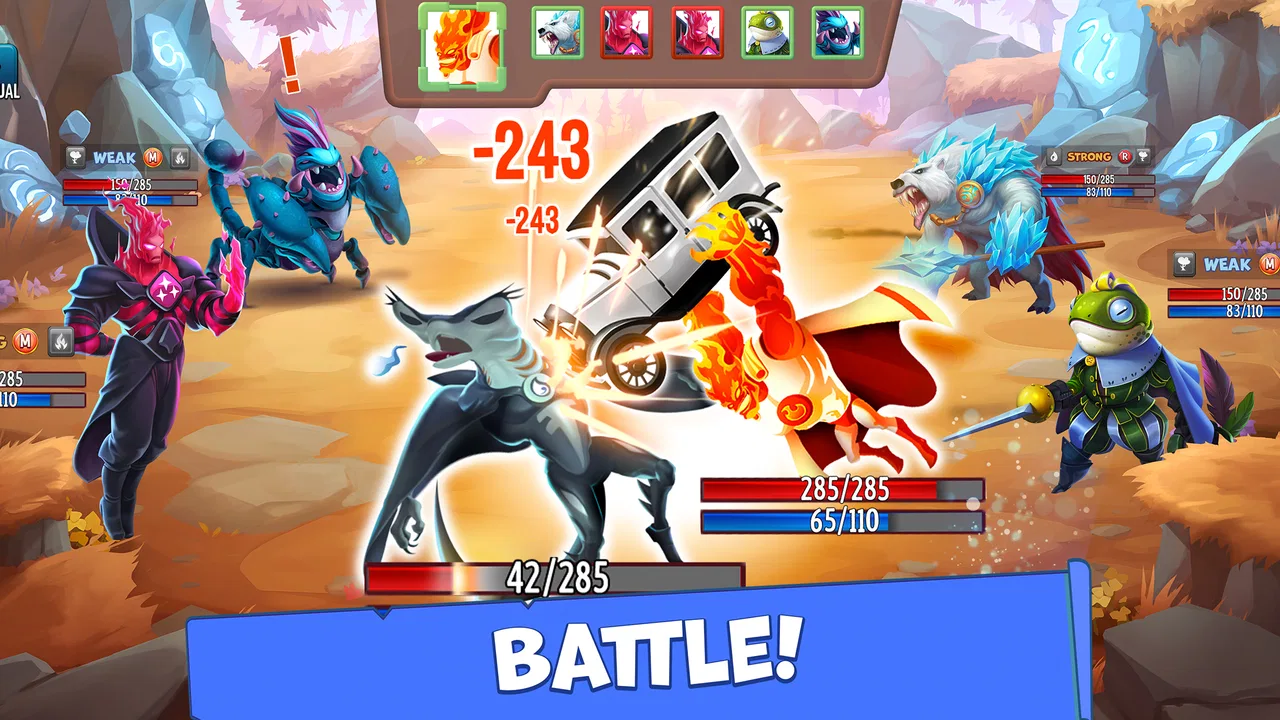
In Monster Legends, breeding involves combining different monsters to create new, unique species. Players must strategize to discover the best combinations. Battles are turn-based, allowing players to use their monsters' abilities to defeat opponents. Success in battles earns rewards and helps players progress through levels and challenges.
05What age group is Monster Legends suitable for?
Monster Legends is suitable for players aged 10 and older. The game features mild fantasy violence and requires strategic thinking, making it engaging for both younger and older audiences. Parents can feel comfortable with the content, and there are options to manage in-app purchases to ensure a safe gaming experience for children.
Pros
- Engaging strategy gameplay with diverse monsters.
- Regular updates keep content fresh and exciting.
- User-friendly interface for easy navigation.
- Strong community support and active forums.
- Cross-platform play available for greater access.
Cons
- In-app purchases can be quite expensive.
- Requires a stable internet connection.
- Energy system limits extended playtime.
- Some features may feel repetitive over time.
- Occasional bugs can disrupt gameplay.

Monster Legends
Gallery